

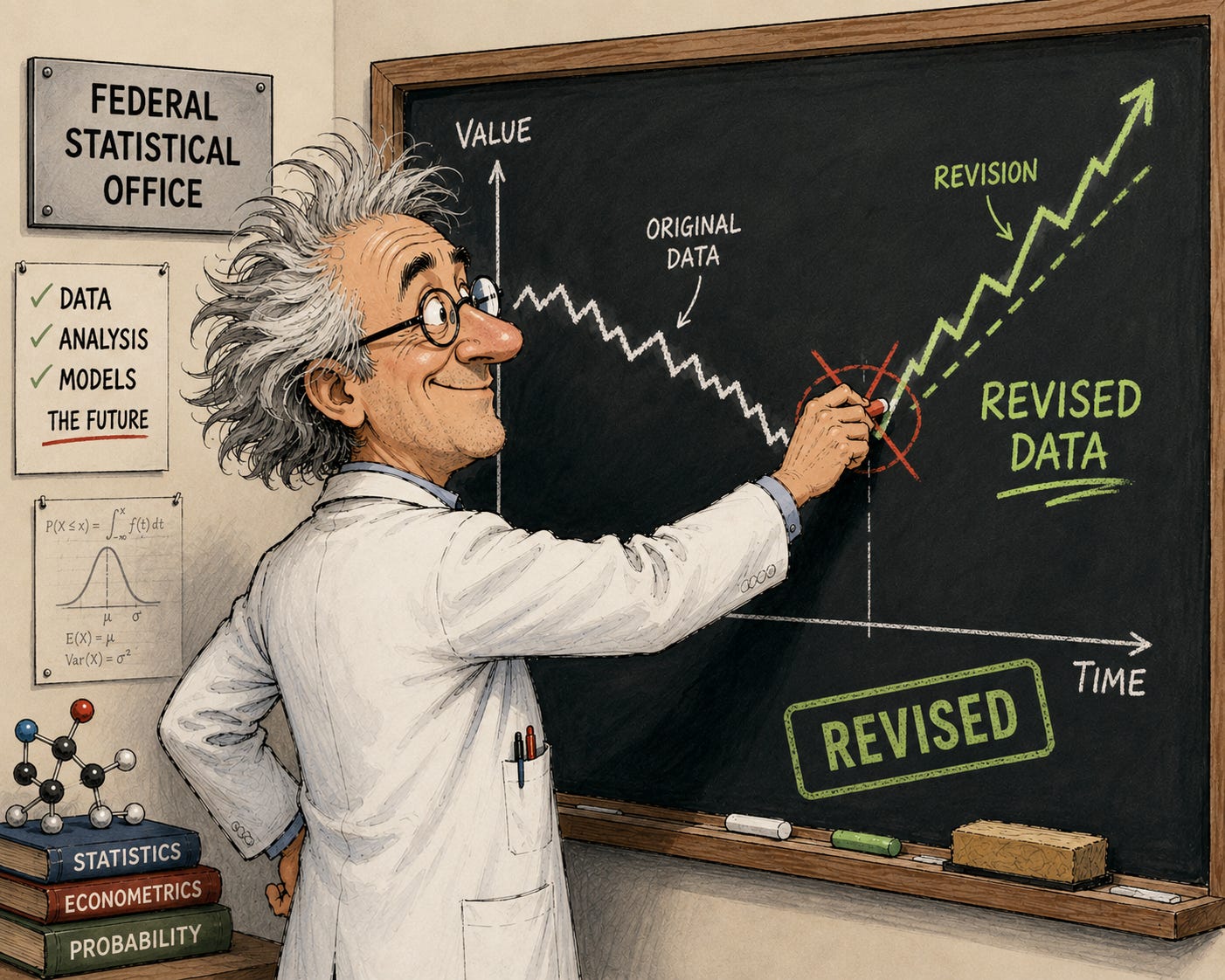
GDP revisions often receive less public attention than new GDP releases. This is a pity, as sometimes they provide greater informational value and bigger surprises than data releases for the most recent quarter.
The most recent revision of German GDP (of which the Federal Statistics Office Destatis published the details today) is a case in point. While commentators and politicians in Germany are still whining that the German economy is stagnating and no escape from years of recession is in sight, current data tells a slightly different story.
Before the revision, German GDP in early 2026 had still been almost one percent shy of its peak in 2022. With the revision, it has surpassed that peak by the second quarter of this year (see figure). Moreover, prior to the revision, Germany’s annual GDP shrank visibly in both 2023 and 2024, with a further technical recession (defined as two quarters of shrinking GDP) in the second half of 2025. With the new data, the drop in 2024 is less pronounced and the technical recession in 2025 has all but disappeared.

But interestingly, the largest consequences of the revision are for this year’s (2026) GDP. For statistical reasons, the last quarters of a year have an impact on the following year’s measured GDP increase (they basically increase the starting point, so that higher GDP towards a year’s end increases the following year’s GDP growth). With a similar logic, growth in a year’s first quarter has a larger impact on a year’s GDP growth than growth in subsequent quarters. In this specific case, revisions have been especially strong for the last quarters of 2025 and the first quarter of 2026.
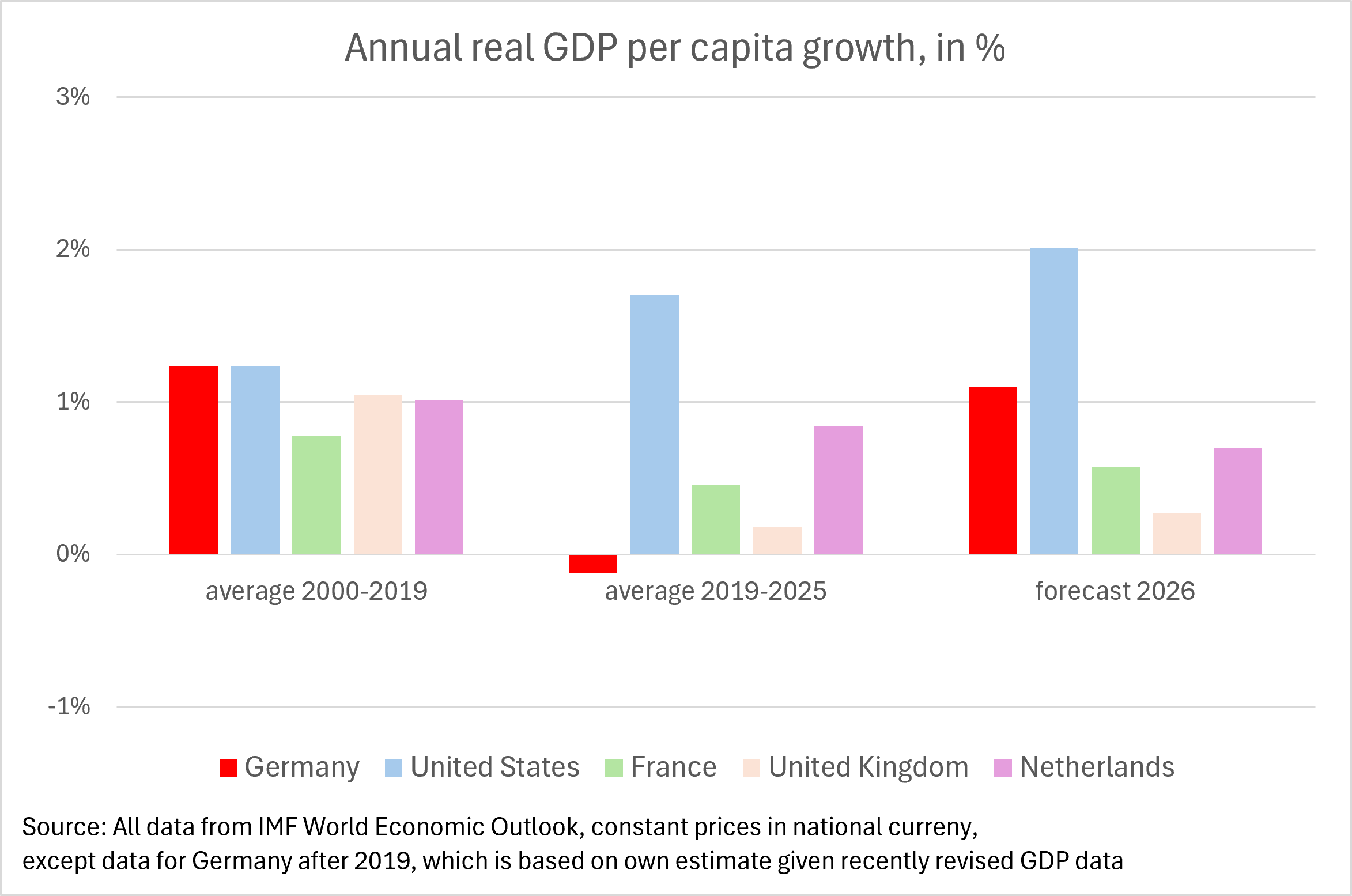
Based on the pre-revision data, in June, we at the Macroeconomic Policy Institute (IMK) forecast a real GDP growth rate of 0.7 percent for Germany (non-calendar adjusted, as is commonly reported in Germany) for 2026. Without changing our view of the future, the revision to past data now means that German GDP would increase by about 1.2 percent this year.
Given that the German population is slightly shrinking, this translates into GDP per capita growth of about 1.1 percent in calendar-adjusted terms¹ for the current year.
Now, this is not a great growth rate. However, it is also not a dismal growth rate. It is higher than what other important Western European economies such as France, the UK or the Netherlands are set to achieve this year, and is not far from what Germany and the United States both achieved on average from 2000 to 2019 (yes, the U.S. and Germany during that period had very similar growth rates when we look at real GDP per capita).
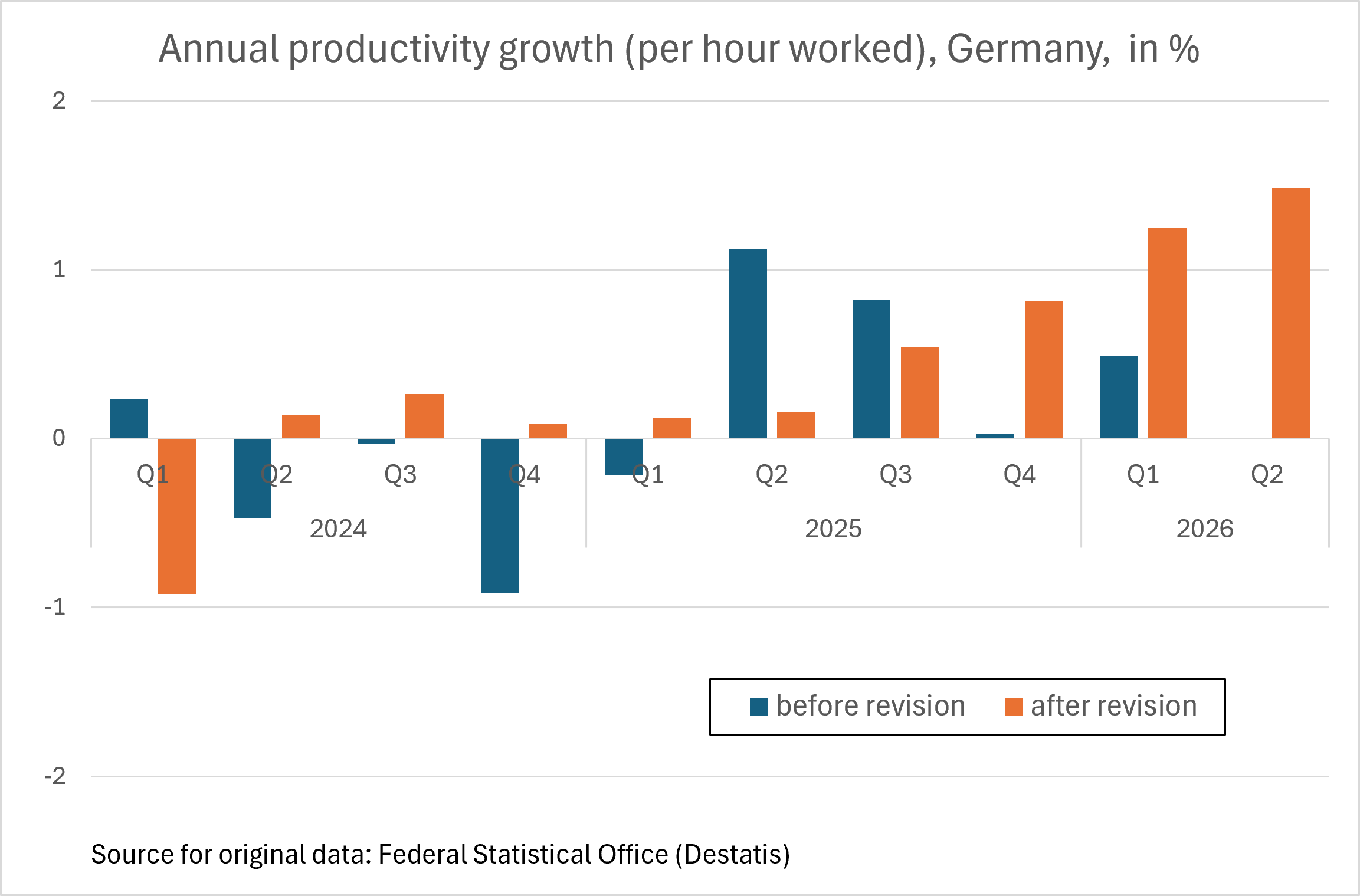
Also, when it comes to productivity growth, a number economists closely watch, the picture has changed massively. Part of the German debate had been preoccupied with low and stagnant productivity growth over the past years. New data now points at a steady acceleration of productivity growth (measured as GDP per hour worked) since early 2025 and at an annual growth rate of around 1.5 percent in the latest quarter. This is far from stagnant productivity and actually better than the average of the years 2000-2019.
Certainly, the revision does not completely rewrite history. In the data, you still see the dramatic fallout of the huge energy price shock triggered by the Russian invasion of Ukraine in 2022 and the damaging fiscal response in 2023 and 2024. The first half of the 2020s was clearly half of a lost decade for Germany.
Also, the latest pick-up in productivity growth does little to close the accumulated gap in productivity growth between Germany (and Europe) and the U.S. economy (see the debate by Paul Krugman and replies by Noah Smith and Pieter and Louis Garicano). The acceleration in Germany is just too recent to wipe out years (basically since Covid) of U.S. productivity pulling ahead. Yet, again, Germany here is not the laggard anymore, and the productivity gap with the U.S. seems rather a European than a German issue.
The new data also does not solve the problems German manufacturing is increasingly having with subsidized Chinese competition which is now debated under the term China Shock 2.0, coined by Sander Tordoir.
Yet, if German policymakers took note, they might at least take a deep breath and see that Germany is no longer an exception in terms of its growth performance, but rather part of a Europe that is struggling with the new geoeconomic realities. Ideally, this would nudge them away from proposing ever more silly solutions for the low economic growth performance (such as scrapping national holidays or cutting taxes for pensioners who decide to work longer) and towards focusing on the really important issues, such as the AI- and IT-induced growth gap with the United States and the growing challenge from Chinese competition.
Unfortunately, in times of (perceived) economic crisis, rational analysis and reason are the first things to go out of the window.
Note: I corrected a misleading axis labelling in the figure on per capita GDP growth on August 26.
1 The calendar-effect this year works in the different direction than the population effect. 1.2 percent GDP growth in non-calendar-adjusted terms would translate to about 0.9 percent in calendar-adjusted terms. Adjusted to a per-capita basis, this would be roughly 1.1 percent.
A note on AI
I occasionally use AI tools to create or develop some of the illustrations you see here. The words are mine: all articles and written content are written by me, without AI-generated text.
I agree a lot here. Soft data has also been improving steadily.
Manufacturing PMI came in much stronger than expected same as the ZEW and the ifo Index. It all points towards a more resilient German economy than media is giving it credit for.
Perhaps worthwhile to also note that cutting taxes at the expense of welfare might be catastrophic during a cost of living crisis.. and also why would opening shops on Sundays even matter