

Last week, I wrote about the surprising revision to German GDP data. One feature I did not mention could be important for the outlook in the quarters and years ahead: Private consumption, already an important pillar of GDP growth before the revision, features even more prominently in the new data.
Since the recovery from the first Covid shock in 2021, German economic growth has to a large extent relied on private consumption. The figure below illustrates this relationship: While the other demand components in total contributed negatively to economic growth (with large differences, as public spending increased while external trade and private investment pulled down growth), consumption expanded except in 2023, when the energy crisis triggered by Russia’s invasion of Ukraine bit hard.
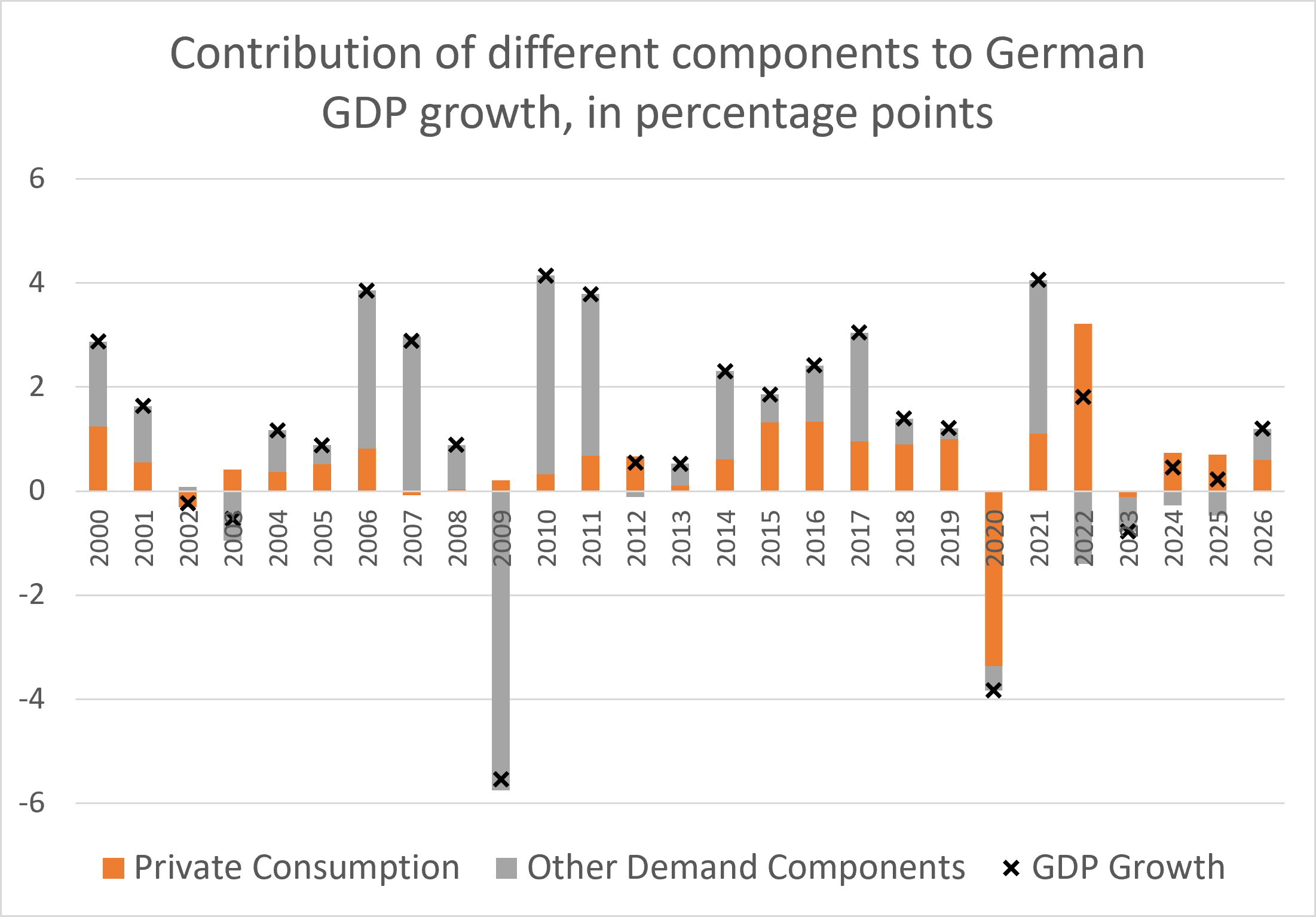
This is especially surprising to those who have observed the German economy over a longer period of time. When I was first introduced to business cycle analysis in the late 1990s, I was taught that the typical German business cycle starts with growing exports, which then lead to an increase in companies’ gross capital formation and only then—with a significant lag—to increases in private consumption.
While none of the business cycles since the 1990s perfectly followed this pattern, until 2020 private consumption never played the role of pace-setter for the economy. This makes the post-Covid period special: Private consumption has been the force preventing a deeper slump for years and one of the forces that led the economy to expand in 2025 and, predictably, in 2026.
As German exports will still be constrained by both U.S. tariffs and growing competition from China, the fate of private consumption will decide how fast the German economy will grow in 2027 and beyond.
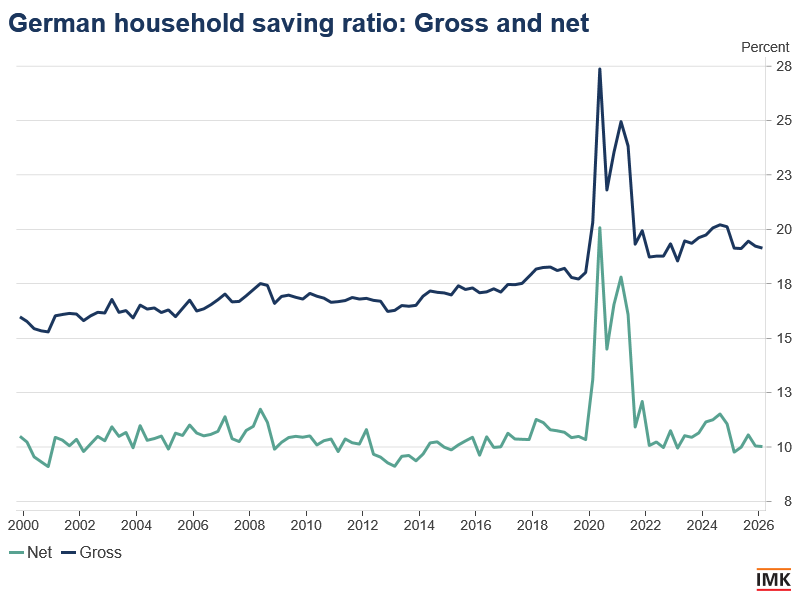
With inflation close to 3 percent, wage incomes are currently growing roughly in line with inflation. For consumption to provide a significant boost to growth, saving ratios would thus have to fall. The question is whether Germans would be willing to save less and spend more. Here, it is important to have a look at current saving behaviour. If Germans were saving more than in the past, one might see potential for more consumption.
Unfortunately for us analysts, measures of gross and net saving tell very different stories: While net saving rates have returned to pre-crisis levels, gross saving rates are still elevated (see figure below). The difference between the two measures is the recording of depreciation on owner-occupied housing. Because construction prices have gone up post-Covid, including relative to other prices, the (hypothetical) depreciation on owner-occupied housing has increased. For net saving, this means a lower rate, while gross saving rates remain unaffected. As we at the IMK believe that most households do not really mentally subtract higher depreciation on their own homes from their income when construction prices rise, we believe that the gross saving ratio is more telling at the moment. Hence, the saving data indicate that there is potential for consumption to play a supportive role in the economic recovery for somewhat longer.
What will predictably weigh on consumption, in contrast, is economic policy. First, planned pension reforms will dampen disposable income. The government’s expert commission on pension reform has proposed increasing social security contributions by 2 percentage points over four years starting in 2028 and investing the funds in diversified international capital markets. The government has already pledged to put this proposal into law.
While there might be good arguments for introducing a capital-based pillar into Germany’s public pension system, we know from the economic literature that there is no free lunch in doing so. On the contrary: Shifting from a pay-as-you-go system to an (even partly) capital-based system always incurs costs for the living generation. An increase in payroll taxes as planned clearly eats into disposable income and—at least judging by empirical evidence from the past—into private consumption demand. Based on macroeconomic simulations, we at the IMK estimate that this could lower economic growth by a total of about one percentage point, distributed over several years.
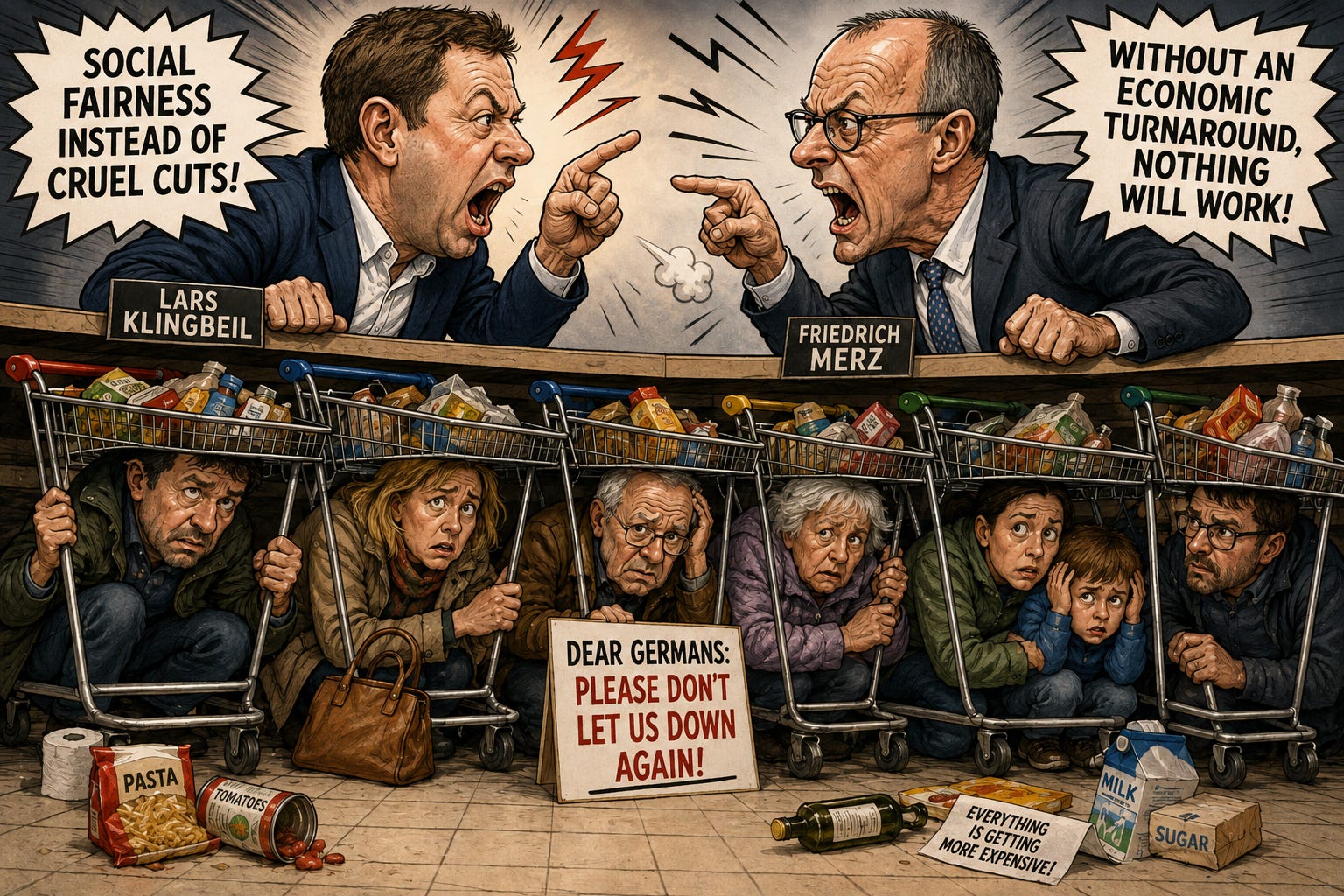
The reform package agreed in July will most likely have fewer tangible, but possibly more psychological, effects. Among the measures decided on were an increase in co-payments for prescription medication, a relaxation of employment protection for those earning more than €177,000 per year, and a new requirement to produce a doctor’s certificate from the first day of sick leave (in the past, this was required after three days of absence). The government’s announcements were accompanied by a heated debate over further cuts to social benefits.
Last week, we published a new survey among German households. 81 percent said that they worry about their own financial situation because of the reform debates, and 76 percent said that they oppose the reforms under discussion. A whopping 42 percent reported that they would limit their consumption because of the debate on health, pension and other welfare reforms.
Now, one could argue that the reforms increase economic growth in a way that boosts consumption through higher incomes and more employment. The catch here is that this only works if the reforms are actually able to create economic growth. This is highly questionable for what was recently decided. I was in an internal meeting between government officials and a number of leading German economists just after the July reform package was announced. Everyone who spoke was basically lauding the government for its reform impetus (I did not comment). When I asked some of the economists present privately after the meeting how much additional economic growth and employment they would put into their own GDP forecasts over the next two years because of the reform package, their estimates were basically indistinguishable from zero (which basically confirmed my priors). None of the big research institutes has yet increased its forecast because of the reform announcements.
So, in total, while German consumption is unlikely to collapse soon, the hope for an additional boost to German economic growth from the German consumer also seems rather optimistic. Unless economic policy (and the policy debate) changes, the recovery is likely to remain one with the handbrake on.
If you know others who are interested in the German economy, please feel free to share this post.
This reveals a policy paradox. Germany needs more domestic consumption to offset a weakening export model, but the response may actually encourage more saving. So for 2027, expectations may matter as much as income. If reforms don’t credibly signal higher future earnings, they could stifle the consumption recovery before any supply-side gains appear.
Interesting how the revised data puts even more emphasis on private consumption. It raises an important question about how sustainable Germany's growth can be if household spending remains such a major driver while investment and trade are holding growth back.